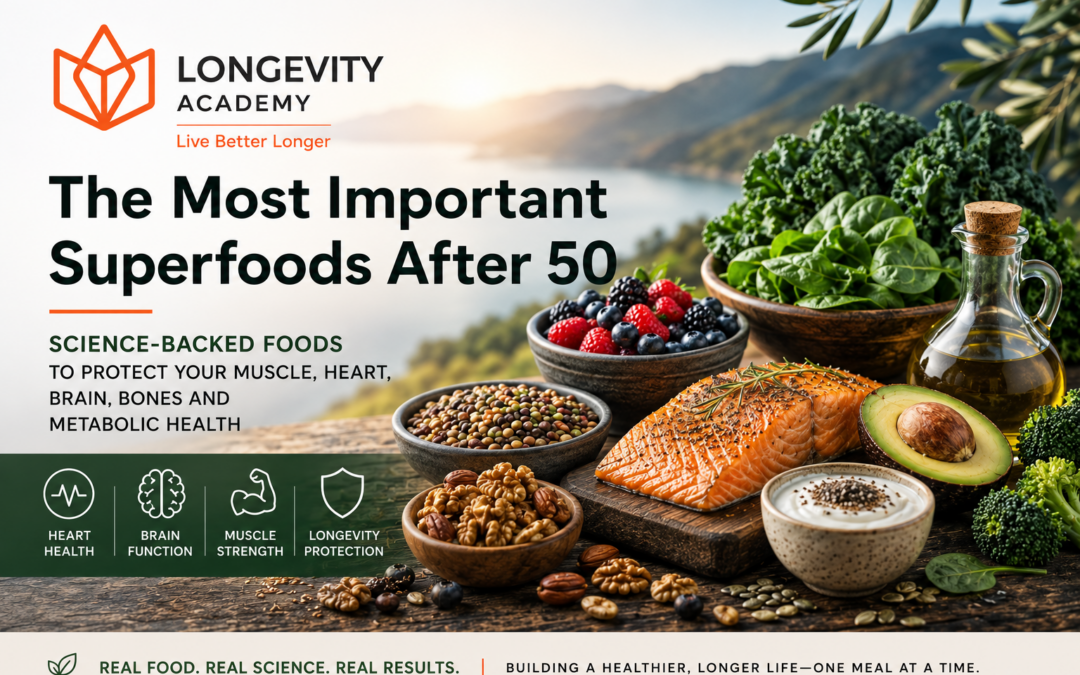
The Most Scientifically Validated Superfoods for Healthy Aging After 50
What the science says you should eat to protect your muscle, heart, brain, bones and metabolic health as you age
The term “superfood” is more marketing language than scientific terminology. There is no formally recognized category of foods that can prevent aging, cure disease or guarantee a longer life.
But that does not mean all foods are equal.
Decades of nutrition research have identified foods and dietary patterns consistently associated with lower cardiovascular risk, better metabolic health, preservation of physical function and, in some studies, healthier cognitive aging. More importantly, several of these findings are supported not only by observational studies but also by randomized controlled trials and systematic reviews.
For adults over 50, nutrition becomes particularly important because the biological priorities begin to change. Maintaining muscle becomes harder. Bone loss accelerates. Insulin sensitivity can decline. Cardiovascular risk rises. Maintaining cognitive function becomes increasingly important. At the same time, calorie requirements may decrease even though requirements for protein and several micronutrients remain substantial.
That means the nutritional goal after 50 should not simply be to eat less.
It should be to get more nutritional value from the food you eat.
The strongest overall evidence points toward a Mediterranean-style dietary pattern: vegetables, fruits, legumes, whole grains, nuts, seeds, fish and extra-virgin olive oil, combined with adequate high-quality protein and relatively little ultra-processed food.
The landmark PREDIMED trial studied 7,447 adults ages 55–80 at elevated cardiovascular risk. Participants assigned to Mediterranean diets supplemented with extra-virgin olive oil or nuts experienced substantially fewer major cardiovascular events than those assigned to the control diet. (New England Journal of Medicine)
More recently, research continues to reinforce a fundamental point: the quality of the overall diet matters more than chasing one miracle ingredient. Current American Heart Association guidance emphasizes vegetables, fruits, whole grains, healthy protein sources, unsaturated fats and minimally processed foods while minimizing added sugars, excess sodium and ultra-processed foods. (professional.heart.org)
So rather than looking for exotic powders or expensive berries from the other side of the world, start with the foods that have the strongest evidence behind them.
1. Fatty Fish: One of the Best Protein Foods After 50
If there is one animal food that deserves a prominent place in a longevity-focused diet, it is fatty fish.
Salmon, sardines, trout, anchovies and similar fish provide an unusually valuable combination of high-quality protein, omega-3 fatty acids, vitamin B12, selenium and, in some species, vitamin D.
That combination becomes particularly relevant after 50.
Protein helps preserve skeletal muscle. Omega-3 fats—particularly EPA and DHA—have important roles in cardiovascular and neurological physiology. Fish can also replace foods with less favorable nutritional profiles, such as processed meat.
For healthy aging, the substitution effect matters. Eating salmon instead of processed sausage is not simply adding omega-3s; it is simultaneously removing a food associated with less favorable long-term health outcomes.
The evidence for omega-3 supplements is considerably more complicated than popular marketing suggests. Eating fish within a healthy dietary pattern has stronger support than assuming that taking large doses of fish-oil capsules will reproduce all of the benefits associated with fish consumption.
Practical target: Aim for approximately two servings of fish per week, emphasizing fatty varieties such as salmon, sardines and trout.
Sardines deserve special attention for older adults because edible bones can also provide calcium.
2. Extra-Virgin Olive Oil: The Foundation of a Healthy Fat Strategy
Few foods have been studied as extensively within a successful dietary intervention as extra-virgin olive oil, or EVOO.
Olive oil is rich in monounsaturated fatty acids, but high-quality extra-virgin olive oil also contains polyphenols and other bioactive compounds.
The PREDIMED trial provides particularly important evidence because extra-virgin olive oil was incorporated into a Mediterranean dietary pattern that reduced cardiovascular events among high-risk adults. (New England Journal of Medicine)
The key is not simply adding olive oil to an unhealthy diet.
Use it as a replacement.
Replace butter-heavy sauces, certain saturated-fat-rich spreads and less healthful fats with extra-virgin olive oil. Use it on vegetables and salads. Combine it with beans, lentils and whole grains.
This creates a dietary environment in which healthy foods reinforce one another.
That is a recurring principle in longevity nutrition: food synergy matters.
A salad containing leafy greens, tomatoes, beans, walnuts and extra-virgin olive oil is nutritionally more interesting than obsessing over whether one ingredient qualifies as the ultimate superfood.
Practical target: Make extra-virgin olive oil one of your primary culinary fats. Portion size still matters because all oils are energy dense.
3. Nuts: Small Foods With Outsized Nutritional Value
Walnuts, almonds, pistachios, pecans and other nuts combine unsaturated fats, protein, fiber, magnesium, vitamin E, phytosterols and numerous phytochemicals.
Walnuts are particularly interesting because they also contain alpha-linolenic acid, or ALA, a plant-based omega-3 fatty acid.
Nuts were one of the key components of the Mediterranean dietary intervention in PREDIMED. (New England Journal of Medicine)
Their cardiovascular benefits probably arise from multiple mechanisms rather than one “magic” nutrient. Replacing foods rich in refined carbohydrates or saturated fat with nuts can improve the overall fatty-acid profile of the diet while adding fiber and micronutrients.
For adults over 50, nuts also have another advantage: they are extremely nutrient dense.
That can be valuable as energy needs gradually decrease but nutrient requirements remain significant.
The caveat is obvious: nuts are calorie dense. A handful is a useful serving. Eating half a container while watching television is something different.
Practical target: About one ounce—a small handful—on most days.
Try walnuts in oatmeal, almonds with fruit, pistachios as a snack or mixed nuts instead of cookies or chips.
4. Berries: A High-Value Source of Polyphenols
Blueberries, strawberries, blackberries and raspberries are among the best ways to increase intake of anthocyanins and other flavonoids.
These compounds have generated considerable interest because of their potential effects on vascular function, oxidative stress, inflammation and neurological health.
Research investigating Mediterranean and brain-focused dietary patterns suggests that diets rich in plant foods—including berries—may contribute to healthier cognitive aging. However, it is important not to exaggerate the evidence: berries have not been proven to prevent Alzheimer’s disease.
The broader evidence for Mediterranean-style eating and cognition is encouraging, with systematic reviews finding associations with better global cognitive function and some benefits in randomized studies. (PubMed)
Berries also solve another nutritional problem beautifully.
They provide sweetness without the concentrated added sugar found in desserts, candy and many packaged snacks.
They are relatively fiber-rich and can be combined with other high-value foods.
Consider a breakfast consisting of plain Greek yogurt, blueberries, walnuts, ground flaxseed and oats. Instead of searching for one superfood, you have created an entire healthy-aging meal.
Frozen berries are perfectly reasonable. There is no requirement that longevity foods be fresh, expensive or exotic.
Practical target: Several servings per week, preferably using berries to replace lower-quality sweets.
5. Leafy Green Vegetables: A Daily Longevity Staple
Spinach, kale, arugula, Swiss chard, collard greens and other leafy vegetables contain folate, vitamin K, carotenoids, magnesium, potassium, dietary nitrate and numerous phytochemicals.
Leafy greens are prominently represented in Mediterranean and MIND-style eating patterns.
Observational research has linked higher consumption of leafy vegetables with slower cognitive decline, although such studies cannot establish that spinach itself prevents dementia.
The biological rationale is nevertheless compelling. Leafy vegetables provide compounds relevant to vascular function, blood pressure regulation, eye health and cellular metabolism.
This illustrates another important longevity principle:
What is good for your vascular system is frequently good for your brain.
The brain is extraordinarily dependent upon healthy blood flow. Strategies that protect cardiovascular health throughout midlife may therefore contribute indirectly to healthier cognitive aging.
Try to rotate your greens rather than relying exclusively on one vegetable.
Practical target: Include leafy greens most days.
They can be consumed raw in salads, blended into smoothies, sautéed with olive oil, added to soups or incorporated into omelets and grain bowls.
6. Cruciferous Vegetables: Broccoli, Brussels Sprouts, Cabbage and Cauliflower
Broccoli, Brussels sprouts, cabbage, cauliflower, bok choy and related vegetables belong to the cruciferous family.
They provide fiber, folate, vitamin C, vitamin K and glucosinolate compounds that can be metabolized into biologically active substances such as isothiocyanates.
These compounds have attracted substantial cancer-prevention research.
That does not mean broccoli cures or prevents cancer by itself. Human cancer biology is far too complex for that claim.
The stronger conclusion is simpler: diets rich in vegetables—including cruciferous vegetables—consistently appear in dietary patterns associated with better long-term health.
The American Heart Association’s current guidance similarly emphasizes eating a wide variety of fruits and vegetables rather than focusing on one specific vegetable. (professional.heart.org)
Variety matters because different plants deliver different fibers, phytochemicals and micronutrients.
Practical target: Eat vegetables at least twice daily and include cruciferous vegetables several times each week.
7. Beans and Lentils: The Underappreciated Longevity Food
If there is an inexpensive food that deserves far more attention in longevity circles, it is the humble legume.
Lentils, chickpeas, black beans, kidney beans, cannellini beans, peas and other legumes provide a combination of plant protein, soluble and insoluble fiber, resistant starch, potassium, magnesium, folate and polyphenols.
That combination supports several priorities simultaneously:
cardiovascular health, metabolic health, digestive health and protein intake.
Research examining prospective studies has associated higher legume consumption with lower all-cause mortality, although the certainty of evidence varies by outcome and should not be interpreted as proof that beans themselves extend lifespan. (PubMed)
Legumes are especially powerful when used as a replacement.
Replacing some processed meat or refined carbohydrates with lentils or beans changes the nutritional architecture of the meal dramatically.
A lentil soup with vegetables and olive oil is inexpensive, filling, fiber rich and nutritionally dense.
Practical target: Eat beans, lentils or other legumes at least three times per week; daily consumption is reasonable if well tolerated.
If you currently eat little fiber, increase legumes gradually to give the gastrointestinal system time to adapt.
8. Whole Grains: Oats, Barley and Other High-Fiber Carbohydrates
Carbohydrates should not be treated as a single nutritional category.
A bowl of steel-cut oats and a frosted doughnut may both contain carbohydrates, but metabolically and nutritionally they are very different foods.
Whole grains retain the bran, germ and endosperm and consequently provide more fiber, minerals and phytochemicals than highly refined grains.
Oats and barley are particularly interesting because they contain beta-glucan, a soluble fiber associated with reductions in LDL cholesterol.
Whole grains also help increase total dietary fiber—one of the most consistently beneficial components of healthy dietary patterns.
Current cardiovascular guidance specifically recommends choosing foods made primarily with whole grains rather than refined grains. (professional.heart.org)
For adults over 50, higher-fiber carbohydrates can also improve satiety, bowel regularity and post-meal glucose control compared with many refined alternatives.
Practical target: Make most of your grain choices whole grains.
Excellent options include oats, barley, quinoa, farro, brown rice and minimally processed whole-grain breads.
9. Plain Greek Yogurt and Other Fermented Foods
The microbiome has become one of the most heavily marketed areas of longevity science. Some claims are far ahead of the evidence.
But fermented foods remain interesting.
Plain Greek yogurt offers something especially useful after 50: it combines fermentation with substantial protein, calcium and vitamin B12.
Kefir is another useful option.
Fermented vegetables such as sauerkraut and kimchi can contribute microbial diversity and plant compounds, although sodium content can be high.
The microbiome research is still evolving, and we should avoid claiming that a particular yogurt will “fix” the gut.
What we can say is that fermented foods can be incorporated into a diverse, fiber-rich diet, and controlled research has shown that higher fermented-food intake can influence microbiome diversity and inflammatory markers.
For aging adults, Greek yogurt is particularly attractive because it addresses muscle and bone nutrition simultaneously.
Choose plain varieties rather than products containing large quantities of added sugar.
Practical target: If tolerated, include plain yogurt, kefir or another fermented food regularly.
10. Soy Foods: Tofu, Tempeh and Edamame
Soy is sometimes overlooked in Western diets despite having a strong nutritional profile.
Tofu, tempeh and edamame provide high-quality plant protein along with minerals and isoflavones.
For adults trying to increase protein while reducing reliance on processed or high-saturated-fat meats, soy can be extremely useful.
Tempeh has the additional advantage of being fermented. Calcium-set tofu can contribute meaningfully to calcium intake.
Soy foods should be distinguished from highly processed foods that happen to contain isolated soy ingredients. A bowl of edamame and an ultra-processed snack bar containing soy protein isolate are not nutritionally equivalent.
This is another example of why food form matters.
Practical target: Incorporate minimally processed soy foods several times per week if you enjoy them.
11. Seeds: Flax, Chia, Pumpkin and Hemp
Seeds are another compact way to increase the nutrient density of a meal.
Ground flaxseed provides fiber, lignans and ALA omega-3 fatty acids. Chia provides substantial fiber along with ALA. Pumpkin seeds provide magnesium, zinc and protein. Hemp seeds add protein and unsaturated fats.
They are not substitutes for fatty fish because the conversion of plant-derived ALA into EPA and DHA is limited.
But they complement a healthy diet extremely well.
Ground flaxseed can be added to yogurt or oatmeal. Chia can be incorporated into overnight oats. Pumpkin seeds work well in salads.
Practical target: One or two tablespoons of seeds per day is an easy strategy for many people.
12. Eggs: Nutrient Dense, Convenient and Protein Rich
Eggs occupy a strange place in nutrition discussions because decades of debate about dietary cholesterol have overshadowed their broader nutritional value.
Eggs provide high-quality protein, choline, vitamin B12, selenium and the carotenoids lutein and zeaxanthin.
Choline is particularly relevant to neurological function, while lutein and zeaxanthin are important to eye health.
For most healthy people, the American Heart Association has indicated that approximately one whole egg per day can fit within a healthy dietary pattern, while people with dyslipidemia, diabetes or certain cardiovascular conditions may require more individualized advice. (professional.heart.org)
What matters enormously is what accompanies the egg.
Eggs with spinach, tomatoes and avocado are nutritionally different from eggs routinely accompanied by bacon, sausage, refined toast and butter.
The food pattern wins again.
13. Prunes: A Surprisingly Interesting Food for Bone Health
Prunes rarely appear on fashionable superfood lists, but they deserve attention—particularly for postmenopausal women.
Several controlled studies have investigated prune consumption and bone health, with evidence suggesting potential benefits for preservation of bone mineral density in postmenopausal women.
Prunes also provide fiber, potassium and polyphenols.
The evidence is not strong enough to suggest that everyone over 50 needs to eat prunes, and they should not replace established osteoporosis prevention or treatment strategies.
But they are a good example of a relatively ordinary food with legitimate scientific interest.
They can also help support bowel regularity, which becomes an increasingly common concern with age.
14. Avocados: Useful, but Not Magic
Avocados contain monounsaturated fat, fiber, potassium, folate and numerous phytochemicals.
They fit extremely well within a Mediterranean-style diet and can replace less favorable sources of fat.
But avocado illustrates an important distinction.
A food can be very healthy without being miraculous.
The evidence supporting Mediterranean dietary patterns, nuts, whole grains, legumes and extra-virgin olive oil is stronger than the evidence that adding avocado specifically will extend life.
Eat avocado because it is a nutritious whole food, not because social media labels it a longevity hack.
15. Coffee and Tea: Optional Longevity Beverages
Coffee and tea contain hundreds of biologically active compounds, including polyphenols.
Large observational studies frequently associate moderate coffee consumption with lower risks of several chronic diseases and lower mortality. But observational associations do not prove that coffee itself causes longer life.
Coffee also affects people differently.
For some, caffeine interferes with sleep, increases anxiety, worsens reflux or causes palpitations. Destroying sleep quality in pursuit of coffee’s theoretical longevity benefits makes little sense.
Green and black teas provide another source of polyphenols with less caffeine than many coffees.
Water should remain the primary hydration source.
Think of coffee and tea as optional beneficial foods, not requirements.
The Nutrient That Becomes Increasingly Important After 50: Protein
No discussion of nutrition after 50 is complete without addressing protein.
Age-related muscle loss—sarcopenia—is one of the greatest threats to long-term independence.
Muscle is not merely cosmetic.
It helps regulate glucose, protects joints, supports bone, generates power, maintains balance and gives you the physical reserve required to recover from illness or injury.
As people age, muscle can become less responsive to smaller doses of dietary protein, a phenomenon often described as anabolic resistance.
European clinical nutrition guidance recommends at least 1.0 gram of protein per kilogram of body weight per day for older adults and notes that approximately 1.0–1.2 g/kg/day has been suggested for healthy older people, with higher requirements sometimes appropriate during illness. (ESPN)
Protein requirements should be individualized based on body size, activity, health status and kidney function.
For many active adults, a practical approach is to include a meaningful protein source at every meal rather than eating very little protein during the day and consuming most of it at dinner.
Fish, Greek yogurt, eggs, tofu, tempeh, beans, lentils, poultry and other minimally processed protein sources can all contribute.
And protein alone is not enough.
Resistance training provides the stimulus. Protein provides building material.
For healthy aging, you want both.
Fiber May Be the Most Underrated Longevity Nutrient
If protein is essential for preserving muscle, fiber may be the most underappreciated component of metabolic and gastrointestinal health.
Fiber comes packaged naturally in vegetables, fruits, legumes, whole grains, nuts and seeds—the same foods that repeatedly appear in successful dietary patterns.
Fiber helps regulate bowel function, improves satiety, slows carbohydrate absorption and provides substrates that gut microorganisms can metabolize into compounds such as short-chain fatty acids.
A high-fiber diet also tends to displace ultra-processed foods.
Rather than obsessing over probiotic supplements, many adults would probably benefit more from simply eating more beans, oats, vegetables, berries, nuts and seeds.
Increase fiber gradually and maintain adequate fluid intake.
Don’t Forget Calcium, Vitamin D and Vitamin B12
After 50, nutrient density becomes increasingly important.
Bone health deserves particular attention. Calcium-rich foods include yogurt, milk, fortified alternatives, calcium-set tofu and fish with edible bones such as sardines.
Vitamin D is harder to obtain from food alone. Fatty fish and fortified foods can contribute, but vitamin D status may require individualized assessment.
Vitamin B12 is another nutrient worth watching because absorption can become less efficient with age. Fish, meat, eggs and dairy provide B12, while fortified foods can be particularly useful for people eating mostly plant-based diets.
This is where targeted supplementation can sometimes make sense.
The principle should generally be:
Food establishes the foundation. Supplements fill legitimate gaps.
Supplements should not be used to compensate for a chronically poor diet.
What You Eat Less of Matters Too
Adding blueberries to breakfast does not neutralize an otherwise ultra-processed diet.
The foods displaced from the diet matter almost as much as the foods added.
Current cardiovascular guidance recommends emphasizing minimally processed foods while reducing ultra-processed foods, added sugars, excess sodium and foods rich in saturated fat. (professional.heart.org)
Processed meat deserves particular attention. The World Health Organization’s International Agency for Research on Cancer has concluded that processed meat causes colorectal cancer, based on sufficient evidence in humans.
That does not mean eating one slice of bacon causes cancer.
It means habitual exposure influences risk.
Similarly, sugary beverages, excessive refined carbohydrates and large quantities of ultra-processed snacks can make it much harder to maintain healthy body composition, glucose control and cardiovascular health.
The objective is not dietary perfection.
It is dietary dominance: make high-quality foods the foods that dominate your diet.
The Ultimate 50+ Healthy-Aging Eating Strategy
You do not need 30 supplements, exotic berries or a refrigerator filled with expensive longevity products.
A scientifically defensible strategy is remarkably straightforward.
Build most meals around vegetables and a meaningful protein source. Use extra-virgin olive oil as a primary added fat. Eat berries and other whole fruits. Consume nuts and seeds regularly. Include beans or lentils several times each week. Choose whole grains instead of refined grains. Eat fatty fish approximately twice weekly. Include fermented foods such as plain yogurt or kefir if tolerated. Rotate leafy greens and cruciferous vegetables. Keep ultra-processed foods, processed meats and added sugars from becoming dietary staples.
Most importantly, repeat these behaviors.
The health effects of nutrition accumulate over years and decades, not over a three-week “clean eating” challenge.
A Simple Day of Longevity Nutrition
A healthy-aging day does not have to be complicated.
Breakfast might be plain Greek yogurt with blueberries, walnuts, ground flaxseed and oats.
Lunch might be a large mixed-green salad containing lentils or chickpeas, vegetables, avocado and extra-virgin olive oil, accompanied by a high-quality protein source.
Dinner might include grilled salmon, roasted broccoli or Brussels sprouts and barley or quinoa.
A snack could be an apple with almonds, vegetables with hummus or kefir with berries.
Water, unsweetened tea and, if tolerated, coffee can make up most beverages.
Nothing in that menu is exotic.
That is precisely the point.
The Bottom Line
The science of healthy aging does not tell us that one superfood will make us live to 100.
It tells us something more useful.
Dietary patterns built around vegetables, fruits, legumes, whole grains, nuts, seeds, fish, extra-virgin olive oil and adequate protein are consistently associated with better health outcomes. Randomized trials such as PREDIMED provide particularly strong evidence that Mediterranean-style eating can reduce cardiovascular events in older high-risk adults. (New England Journal of Medicine)
Evidence also suggests that Mediterranean-style patterns may support aspects of cognitive function as people age. (PubMed)
For people over 50, however, there is one modification that deserves particular emphasis:
Protect your muscle.
Eat sufficient protein and perform resistance exercise.
Then build the rest of your diet around plants, fiber, healthy fats and minimally processed foods.
If you want a simple hierarchy, remember this:
Protein: fish, Greek yogurt, eggs, soy, beans and other high-quality sources.
Plants: leafy greens, cruciferous vegetables, berries, other fruits and colorful vegetables.
Fiber: legumes, oats, barley, whole grains, nuts and seeds.
Healthy fats: extra-virgin olive oil, nuts, seeds, avocado and fatty fish.
Fermented foods: plain yogurt, kefir and other minimally processed fermented foods.
Minimize: processed meat, sugary beverages, refined carbohydrates and ultra-processed foods.
The real longevity advantage does not come from discovering the newest superfood.
It comes from eating the proven foods repeatedly for the next 10, 20 and 30 years.
Healthy aging is built through thousands of ordinary meals.
And the best longevity diet is ultimately the one that protects your cardiovascular system, preserves your muscle and bones, supports your brain and metabolic health—and is simple and enjoyable enough that you can continue eating it for the rest of your life.
This article is for general educational purposes and is not individualized medical or nutritional advice. People with kidney disease, diabetes, food allergies, swallowing difficulties or other medical conditions, or those taking medications affected by specific foods or nutrients, may require individualized dietary guidance.
About the Longevity Academy
The Longevity Academy is building the world’s most trusted Intelligence & Operating System for the Longevity Economy.
Our mission is to help individuals, healthcare providers, clinics, investors, entrepreneurs, researchers, and industry leaders navigate the rapidly evolving science and business of extending human healthspan. We accomplish this by delivering independent reporting, expert interviews, market intelligence, educational resources, and one of the nation’s most comprehensive directories of longevity-focused companies and organizations.
Our editorial team is committed to publishing evidence-based, balanced content that translates complex scientific research into practical insights. While we highlight promising innovations, we also emphasize the strength of the evidence, acknowledge uncertainty, and encourage informed decision-making.
In addition to our articles, the Longevity Academy produces the Longevity Leaders Project, featuring conversations with many of the world’s leading innovators in longevity medicine, biotechnology, diagnostics, nutrition, fitness, AI, and healthy aging. We also publish the Longevity Brief, our newsletter covering the latest breakthroughs, business developments, and emerging trends shaping the longevity economy.
Whether you are searching for trusted information, evaluating products and services, discovering leading organizations, or building a business in the longevity sector, the Longevity Academy exists to help you make better decisions—and to accelerate the future of healthy human longevity.
Learn more at: https://longevityacademy.us